Monday, July 2, 2012

July 2, 2012
Po' Monkey Juke Joint
Merigold, Mississippi


Introducing Po' Monkey, proprietor of the world famous Po 'Monkey Juke Joint

Here's a painting of Po' Monkey Juke Joint 

Gentle Reader,

To celebrate our three year anniversary, Scott and I journeyed on the NEH bus to Po' Monkey Juke Joint in Merigold, Mississippi.  There are legends surrounding the man who opens his home for "family night" every Thursday.  This is really the last juke joint around.  It's a very old sharecropper's shack out in the middle of a soybean field.  Po' Monkey farms the field with his tractor by day, and then generously opens his home on Thursday evening to keep the juke joint tradition alive.  He says he got the name Po' Monkey from his Mama, and that he is "poor for sure."  


 No drugs allowed at Po' Monkeys, as per the rules posted.  Also, he is a purist and
wants to stick to blues or jazz... no rap music.  No saggin' allowed, either.  And hats must be with the bill facing out front, the more traditional way. 
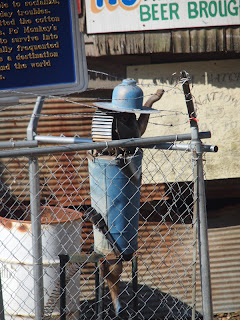
 This is a sculpture that was designed for Po' Monkeys a while back.  It has a spring coil tail, too.
The whole sculpture, including the flag and the surrounding fence, has been dubbed "Fort Monkey."


He is alive with enthusiasm for his guests, and his only desire is that everyone just have a good time.  On his more energetic evenings, he is known to change his clothes several times, emerging to rounds of appreciative applause from his bedroom door.  He has a collection of very colorful suits, and is definitely a dapper gentleman.  On this particular night, which was a sweltering Delta night, he did not change from suit to suit.  Instead, he emerged with various aprons on over his shirt and pants.  He would have "surprises" to reveal as he moved about the dance floor.  

The cover is small, and the music is immensely large.  A DJ cranks out some very danceable tunes all night long.  Joe, one of the NEH participants, was the hit of the party.  He danced with locals as well as the members of the symposium.  He was stylin', jumpin', and jivin' on that dance floor, giving some of the ladies a real thrill, I think.  He swirled around the floor with Lee Alyward, one of the workshop instructors, transforming her into a "juke joint woman" all evening long.  For decor, stuffed monkeys hang from the ceiling.  Visitors from all over the world, who have experienced Po' Monkeys, send stuffed animal monkeys for Po' Monkey to hang all over the joint.  Staring up at monkey butt while dancing, or colliding with a monkey tail or leg is a common occurrence at this juke joint.

On the bus on the way over, we finally broke into song.  Everything from "This Little Light of Mine," to honor Fannie Lou Hamer's contributions to the Civil Rights Movement to "Precious Lord, Take My Hand, " to some original blues by one of the NEH members.    

Earlier in the day, we listened to "Juke Joint Woman" as our "Song of the Day."  A rollickin' good time, which even got Lee dancing in the aisles of the bus.  The song ends with the sweet line:  "All this juke joint woman is gonna give you is a heart attack..."

In a New York Times article published March 2, 2007, reporter Erik Ekholm writes a features about Po'Monkey Juke Joint.  Below are some excerpts from the article, with some commentary by Po' Monkey himself.  If you want to read the whole article, which I would highly recommend, go to www.nytimes.com/2007/03/02/us/02jukejoint.


Char, Diana, and Rachelle at the juke joint

Po' Monkey sells soda pop and cups of ice.  He also sells beer.  He doesn't purchase this from a distributor. He just goes down to the local grocery every Thursday afternoon and stocks up for the evening's festivities.  Customers can bring in hard liquor or wine, but the mixers and beer must be purchased at the swing door counter.

From the interview in the New York Times...

“Po’ Monkey is all anybody ever called me since I was little,” he said. “I don’t know why, except I was poor for sure."
He doesn’t recall any blues stars ever playing at his club, which has live music on special occasions. 
The place doesn’t make much, he said — guests pay $5 to enter and can buy beer or bring their own liquor and buy mixers. The pool table costs 75 cents a game."
“I was going to get married once, even got a license,” he said, “but we started getting into it, and the preacher never did register that license.”

The spirit of the juke joint is alive and well in Merigold, thanks to Po' Monkey and his generosity...!  What a time we had that night... Happy anniversary to Scott and me...


Namaste,
Marianne


July 2, 2012
New Friends


Gentle Reader,

This symposium has been jam-packed with learning, even using our bus rides as a "classroom on wheels."  As a result, there is very little down time.  We begin most mornings at 7:30 or 8:00 am, often finishing at 9 or 10 pm.  We did have a little free time two evenings when we finished sessions at 7pm.  We've met some phenomenal folks on this journey, especially Brad and Erin, who met one another a few years ago on a Close Up Program for their students in Washington D. C.  Naturally, we had some relationship similarities to talk about and reminisce about, having each met our partners at workshops far away from home.  

We met at a local joint called Airport Grocery for some tasty BBQ nachos, which were served on chips instead of tortilla chips.  

Thanks, Brad, for helping me with the technology aspects of this workshop! (As Tony Gendreau once said when I asked him a tech question:  "Are you Amish?" )  Thanks, Erin, for keeping Scott company on your trips to the BB King Museum and Vicksburg!  It was good getting to know y'all!!!!


"People keep asking me where the blues started and all I can say is that when I was a boy we always was singing in the fields. Not real singing, you know, just hollerin', but we made up our songs about things that was happening to us at the time, and I think that's where the blues started."

                                                                                         - Delta bluesman Son House, 1965

May you continue to record your journey, the story of what your life is all about, in song or poetry or painting or photography...or whatever tells your unique story in the most intimate and personal way...

Namaste,
Marianne

July 2, 2012
Bill Abel and the History of the Blues


"The blues is the truthful expression of soulfulness..."
-Bill Abel, blues artist

Gentle Reader,


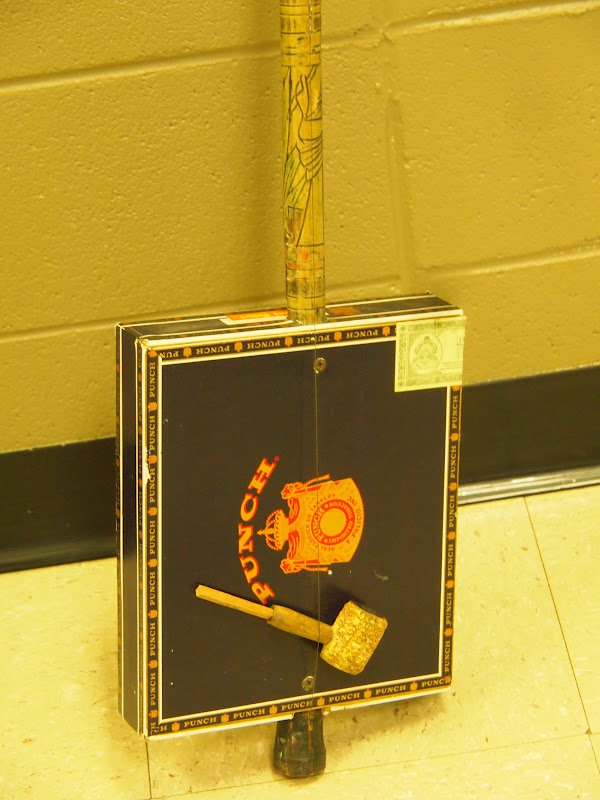
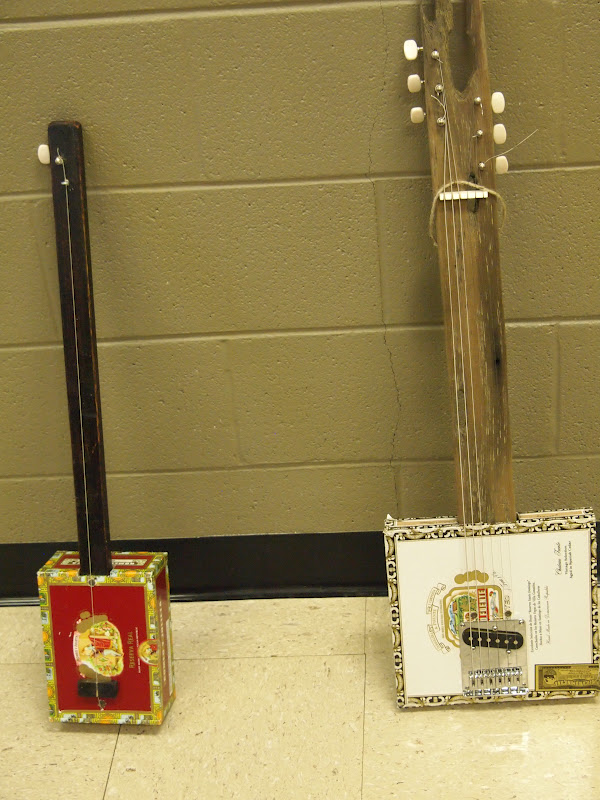
We had a very special treat on this evening!  Bill Abel, blues singer and historian, joined us for an evening of music and learning about the Delta Blues.  He is a consummate artist and personable beyond measure.  He constructs many of his instruments from cigar boxes, driftwood from the Mississippi River, etc...  He even offers workshops for young people, guiding them through the process of making their own cigar guitars.


He also shared the technique of making the traditional Diddly Bo, which is a homemade one-stringed instrument.  These were typically built right onto the wall of a house, with the cypress wood providing amazing resonation.  He recommended the book "Africa and the Blues, " which expands on the African influence on the Blues and the role of one-string instruments.  


Bill also talked about how only 10% of the people who were stolen from Africa and brought to the west came to North America.  The other 90% were transported to the Carribean and surrounding areas.  He also spoke about how drums were often banned, largely to quell rebellions and communications that drumming can provide.  However, drumming survived and even thrived in some areas in the Delta.  Further south, in New Orleans, there was Congo Square where freedmen and slaves congregated to play drums and dance. 


If you are looking for a good read about the history of the Blues, Bill recommends "Deep Blues" by Robert Palmer, which covers the evolution of the Blues.  


"...I rambled all the time.  I was just like that, like a rollin' stone..."
                                   -Muddy Waters, Delta bluesman


"Get busy living or get busy dying..."
                                   -Morgan Freeman, owner of Ground Zero 
                                        Blues Club in Clarksdale, Mississippi


I wish you a day filled with the desire to "get busy living"... perhaps even accompanied by the "truth" found in the Delta Blues...


Namaste,
Marianne


July 1, 2012
Religious and Cultural History of The Delta


Gentle Reader,


It has been said that Sunday morning in the United States, to this day, constitutes the most segregated time in this country.  The Southern Church became a sanctuary, a place where social services were obtained, where people were nurtured both in spirit and flesh, and ultimately a place of political leadership.  This was especially true in the African Methodist Episcopal (AME) churches.  It is very clear that the churches served to unite people in powerful ways during the Civil Rights Movement.  


The imagery from the various religions permeate the culture of the South.  Faulkner, for example, used religious imagery because it was all around him.   "It's just there," he once said, when interviewed about his use of religious imagery.  There are signs and symbols along the highway, with modules of cotton spray painted with "Get right with God."  Religion embodied a concrete sense of the relationship between God and human beings.  Reynolds Price once said that "those things that make us most human are taught at the table in table manners," often associated with the practice of saying grace before a meal.  Price also said there is a "bittersweet marination in religion" in the South.  H.L. Mencken,who wasn't very fond of Southern religion practices, said, "...the South is a cesspool of Baptists and a miasma of Methodists." 


 Nevertheless, the church was often the only thing blacks could truly call their own.  It was a place of salvation and beyond, to sanctification as a sort of second blessing. These were spirit-filled religions, with the gifts of the spirit animating the congregations.  Jackson, Mississippi is considered "the buckle of the Bible Belt."  


Our Guest Scholar, Dr. Charles Reagan Wilson, talked about a five finger teaching model, which is designed to instruct children about the what constitutes sin.  Each finger is used to represent a particular reminder about sin:  don't lie or cheat or covet, don't drink alcohol, don't steal, etc...  I could not find a full explanation of this teaching method online, but I did find another "five finger" strategy that is apparently used in many Sunday school lessons.  I'll reprint this teaching method below:


Five fingers prayer method for children


Teaching Kids the Five Finger Prayer

Thumb (people who are close to you) These are your close friends and family, often the first you think about when you pray. Give thanks to God and ask his protection on your parents, siblings, friends, and classmates.
Pointer (people who point the way) These are leaders in your life, such as teachers and pastors. Offer God your thanksgiving for them and ask him to help them in their important work.
Tall Finger (people in authority) The big people in the world need prayer too. Ask God to give wisdom to our government, military, and police.
Ring Finger (people who are weak) This is your weakest finger. We should remember others who are sick, live in poverty, or are treated badly. Pray that Jesus would give them new strength.
Little Finger (your own needs) God wants to hear your needs too, especially when you put others first. Pray for your own growth in mind, body, and spirit.


Another icon of Southern churches that Dr. Wilson discussed was the use of church fans.  These were wildly popular, as the heat was often suffocating and the sermons were often very lengthy. The heat was always "the common enemy," and the church fans brought some relief.  The fans contained a wide array of photos/paintings from history, musical heritage, crops, the film industry, etc...  Most of the time, local businesses would distribute the fans as a way of advertising their business, funeral homes and insurance companies, especially.  On the flip side of the fan would be images of Jesus, or images of John F. Kennedy or Martin Luther King, Jr.  Singers like Mahalia Jackson and Elvis were often featured on the fans.  One fan even offers a cool and refreshing mountain scene, perhaps to transport the mind and spirit to a cooler locale.  Here's Dr. Wilson showing off some of the fans, including a Route 61 fan.  This was and still is an important route in the history of the Mississippi Delta, being the pathway many took to Chicago and other northern cities during the Great Migration in the early part of the 1900's.  


"...A city that sits on a hill can't be hid.  Let your good light shine.."
                           -Matthew 5


Wishing you a day of sweet relief from this suffocating heat this week...  May you find a place to cool your body and refresh your soul...


Namaste,
Marianne

July 1, 2012
Greenville:  Crepe Myrtles and Artwork


Gentle Reader,


Throughout the Delta, we encountered art and beauty almost everywhere we went.  The mural above is quite large and covered a side of a building directly across from the synagogue in Greenville.  There are messages of hope, cooperation, shared suffering, and healing in many of the murals.  The colors are brilliant and alive and offer a sense of deep rootedness as well as hope in times of despair... which parallels the blues music which was birthed in this region, too.


This is one of hundreds of crepe myrtle trees/bushes in the Delta.  They look something like lilacs in the north, but the flowers are thicker, sturdier, and appear to last much longer.  We saw deep pink, light pink, and red crepe myrtles in yards, along the highway, lining the streets of neighborhoods.  Just lovely...

What beauty will you add to the world today?


Namaste,
Marianne
July 2, 2012
Great Flood of 1927 in the Mississippi


"...The people of the Delta fear God and the Mississippi..."


                                                        -David Cohn


Gentle Reader,

The Great Flood of 1927 was devastating in the Delta.  Here are some basic statistics about the damage that the flood had on the land.  However, these stats don't begin to account for the human toll and how this flood experience changed the Delta forever...

*one of most powerful natural disasters of the 1900's

*followed several months of unusually heavy rains in late 1926 and early 1927

*river was over 80 miles wide at some locations, at the height of the flood

*after the failure of the levee at Mounds Landing, Mississippi, the river flowed with the force of Niagara falls

*resulted in flood of an area the size of Connecticut

*ten feet of water covered towns up to 60 miles away from the river

*the area around Mounds Landing was covered with 100 feet of water

*affected an area of 27,000 square miles

*over 130,000 homes were lost

*700,000 people displaced

*246 flood-related deaths reported

*property damage estimated at 350 million dollars, which would be about 5 billion dollars today

We visited the 1927 Flood Museum in Greenville, which is in the same town as the synagogue.  It's a small museum, but very powerful in the depiction of the human suffering and the community spirit that flourished as people tried to survive and help others survive.  A cooperation in the time of severe crisis was very evident in the documents and photographs.  One cannot help but remember the devastation of Hurricane Katrina in the Gulf region while at this museum...


 "It was like facing an angry dark ocean.  The wind was fierce enough that that day it tore away roofs, smashed windows, and blew down the smokestack -- 130 feet high and 54 inches in diameter -- at the giant A.G. Wineman & Sons lumber mill..."
from Rising Tide by John Barry


I saw a whole tree just disappear, sucked under by the current, then saw it shoot up, it must have been a hundred yards away.  Looked like a missile fired by a submarine...
-one man working on the levee recalled, decades later
from Rising Tide by John Barry

 "


John Barry, in his book Rising Tide, says the following about the Flood of 1927:

"...The river threatened their society too... and they would do whatever was required to preserve it...  It began as one of man against nature.  It became on of man against man.  for the flood brought with it also a human storm.  Honor and money collided.  White and black collided.  Regional and national power structures collided.  the collisions shook America...On the levee in downtown Greenville, the men watched the river rage for a few more minutes.  the rain stung.  The river was, literally, awful.  Yet they took a certain pride in its awfulness, in the greatness of the river.  Confronting it made them larger.  For a few more minutes, frozen by it, they stood there. .. They would not go home for hours; some would not go home for days.  they had work to do..."


We learned about Senator Percy during our seminar on The Great Flood of 1927, about his tremendous influence on driving the KKK out of the Mississippi Delta region.  We also learned about the family saga and how events that followed pitted father against son in tragic ways.  Being teachers, we talked about how this story lends itself to a portrayal in tragic proportions, and we even tossed around the idea of having students research the events related to the Percy family and then dramatize them as a "blues opera."  Has potential....!

Namaste,
Marianne